Does Creatine Cause Hair Loss? The Science & Solutions Explained
Reviewed by QHT Clinic
Know Your Hair Fall Before It Worsens
Identify early hairfall signs with personalised expert-backed recovery guidance.
Be it Gen Z or the Millennials, fitness remains the topmost priority of people these days.
With regular workouts and strength training sessions, people are investing in their fitness regime ; trying everything to enhance their appearances.
Supplements are gaining popularity owing to their catalytic role in increasing the muscle mass and resistance of the body.
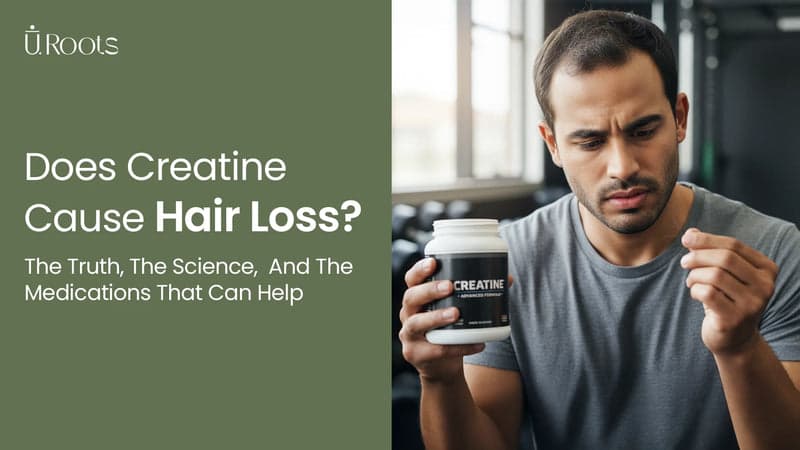
Creatine is one such supplement that is known to increase lean muscle mass, enhance athletic performance,and helps in producing energy during high-intensity workouts.
However, there is a common notion around the intake of creatine :’ It causes hair loss.’
Debunking the myth, the answer to it is ‘No.’
Creatine doesn’t cause hair loss and there is very little to no evidence proving its role in causing hair loss.
At QHT Clinic, we understand the queries of the patients facing hair loss.
Our focus is to help them understand the facts and myths associated with hair loss; providing honest and unsolicited advice.
If you’re someone who has been told to avoid taking creatine as it may cause hair loss, here’s a simple guide to help you make an informed decision.
What is Creatine?
Adenosine triphosphate (ATP), the energy that powers our muscles, is produced with the help of creatine.Our diet provides us with creatine, which our liver, kidneys, and pancreas also manufacture.Our body can only produce a few grams of creatine per day, and we get a pretty small amount from food.Our body stores creatine in our muscles before converting it into quick-acting energy, such as what we need for intense workouts. Three to five grams of creatine should be taken each day.
However, creatine should not be mistaken with protein or anabolic steroids. While drugs have an impact on muscle growth, creatine enhances ATP generation.
Creatine is often confused with steroids.
The difference between creatine and steroids is distinctive.
Creatine is an amino acid. It has a completely different chemical composition than steroids and has a distinct effect on your body. While drugs have an impact on muscle growth, creatine enhances ATP generation.
Protein and creatine both help maintain strong muscles, although they serve distinct purposes. According to researchers, creatine enhances the ATP system and offers quick-acting energy. Unlike creatine, protein is not an effective energy source. It aids in the growth and regeneration of new muscle fibres.
Can hair loss be caused by creatine?
Because creatine affects the hormone dihydrotestosterone (DHT), there is a rising concern regarding creatine and hair loss. A byproduct of testosterone is DHT. It can eventually cause hair loss since it adheres to hair follicles. Creatine may raise DHT, according to some specialists.
After seven days of supplement loading (consuming more creatine), a 2009 study of collegiate rugby players found that their DHT increased by 56%. However, no research has been able to replicate those findings. The effects of creatine on testosterone have been examined in twelve more years of research. No notable increases in hormones have been recorded until the studies done in 2025.
As there’s no significant evidence reported until now, it’s safe to consume creatine as per the recommended dosage.
However, if you’re suffering from hair thinning or hair loss, it is advised to consult a leading endocrinologist to rule out any potential damage that may occur due to its regular consumption.
A complete blood panel test may help to determine any sort of deficiencies.
What does Science say about hair loss associated with creatine?
The notion that creatine may cause hair loss has gained popularity, but what is the true conclusion of scientific research?
It all started as a research performed in the year 2009 on the athletes testing the link between creatine and hair loss.
Twenty male rugby players participated in a 2009 study that raised the primary issue. Following a brief period of creatine loading, researchers noticed a 56% rise in dihydrotestosterone (DHT), a strong androgen hormone that is linked to androgenetic alopecia (male pattern baldness).
However, there are a few crucial disclaimers to take into account:
1. Small sample batch and shorter experiment : The 2009 study only included 20 individuals and tested hormone levels rather than real hair loss or follicle alterations, resulting in a small sample size and short duration.
2. No future follow-ups- There are currently no conclusive studies that show a direct correlation between short-term or long-term supplementation with creatine and hair loss.
3. Contradictory Evidence : A bigger 12-week randomised controlled experiment revealed that participants using creatine did not significantly differ from those receiving a placebo in terms of their DHT levels, testosterone ratios, or scalp hair density.
4. Expert Opinion : Dermatologists and reputable organisations such as the American Hair Loss Association agree that creatine is not a known cause of balding or hair loss.
Final verdict: It is doubtful that most persons who take typical dosages of creatine (3–5g/day) will have hair loss. However, it's a good idea to limit your creatine intake if you have a genetic tendency to androgenetic alopecia.
Potential side effects of creatine
There is little research on creatine and no clinical proof of adverse effects. However, creatine's effects vary from person to person, and some experiments have reported adverse consequences.
The following are possible and researched adverse effects of creatine:
Water retention is the most often reported adverse effect of creatine, particularly in the initial days of consumption. Since sodium, or salt, binds to water, it carries creatine to the muscles.
Athletes often take a higher dose of creatine for several days to optimise performance.
Hence, water retention is more common when people do a 'loading phase' with creatine.’ However, there’s less possibility of water retention if one takes the recommended amount of creatine each day.
The impact of creatine supplementation on kidney function has been thoroughly studied by researchers. The suggested dosage of creatine has not been linked to any adverse effects.
Is there any conclusion of renal trauma or dysfunction? However, if someone is battling renal dysfunction or chronic kidney disease, it's still a good idea to stay away from creatine.
Creatine is usually used when exercising at a high intensity, which causes excessive sweating. Usually, people fear that dehydration and cramping may result from the combination of excessive sweating and potential muscular water retention.
There is no scientific proof to support the claims that creatine causes cramps and dehydration, yet some people do. Conversely, previous research on athletes revealed that using creatine supplements decreased cramping by up to 60%.
Are there any medications that can help with hair loss caused by creatine?
While creatine isn’t associated with hair loss directly, overconsumption of creatine may increase the levels of DHT.
Increased DHT levels may cause Androgenetic Alopecia in males, also known as ‘Male Pattern Hair Loss.’
Over the years, Pumpkin oil has been known to reduce the effect of DHT.
With very little evidence to support, it is known to reduce the binding capacity of DHT hormones on the hair follicles, thereby reducing hair loss and potential hair thinning.
Apart from this, there have been several topical and oral medications available for reducing DHT induced hair loss.
These medications are commonly known as ‘DHT Blockers.’
They block the DHT receptors from binding with the hair follicles, helping to avoid follicle shrinkage and helping the hair regrow.
The two most common medications available in the market to combat DHT related hair loss are: Minoxidil and Finasteride.
Minoxidil
Because oral minoxidil has a documented side effect of encouraging hair growth, it is used off-label to treat hair loss. Minoxidil is often prescribed as a topical application medication for men dealing with pattern hair loss.
Although minoxidil solution is effective in treating hair loss, it is recommended to use it for the long term to see noticeable differences.
Minoxidil and creatine are not directly correlated.
DHT blockage can be associated with Minoxidil.
Finasteride
An FDA-approved drug called finasteride is used to treat androgenetic alopecia, or male pattern baldness. It functions by preventing the 5-alpha-reductase enzyme from converting testosterone to the hormone dihydrotestosterone (DHT), which is associated with hair loss.. It is not an over the counter medication.
It is only available through a doctor’s prescription.
Finasteride helps in reducing hair loss by blocking the DHT receptors, helping in faster hair growth.
What else can be done to deal with hair loss?
Apart from using these medications, one can also opt for derma rolling, derma punches, and low-level laser therapy.
Although the results may take time, combining it with hair growth serums can help in faster hair regrowth.
The hair growth medicines available in the market are composed of essential vitamins and amino acids needed for hair growth.
Consuming these medicines can help in fulfilling the dietary requirements for hair growth, along with a healthy diet.
Hair growth medicines in India basically aim at providing deep nourishment to the hair follicles and help in reducing the inflammation caused to the scalp.
The dermatologists often prescribe these medicines to boost hair growth while targeting the inner nourishment of the hair follicles.
In severe cases, hair thinning and hair loss cannot be avoided, especially in the case of hereditary hair loss.
Genetic predisposition is also responsible for hair loss in men.
In such cases, a hair transplant may be needed.
Why is QHT Clinic the trusted choice for a hair transplant?
AT QHT, every patient is not just our client but more like a family member. The queries are not just heard, but honest suggestions are provided too.
The doctors and their expert team have managed to restore the confidence of the patients and minimise the hair loss caused by genetic predisposition.
The approach is patient, and total transparency is maintained throughout the procedure.
Honest opinion and guidance are provided to each patient to help them attain the best hair transplant result.
With more than 10000+ procedures performed and 30 million+ hair graft implantations, the expert panel understands the intricacies of the hair transplant.
While no false claims are made, the testimonials speak for the authentic results attained at the QHT Clinic.
As daunting as it may seem, trusting the right clinic is essential to fix the issues and restore the lost self-confidence.
While some patients may complain of low density or visible scarring, each patient has a unique concern when it comes to restoring their lost hair.
Being a pioneer in the hair restoration industry, QHT Clinic can help you achieve your desired results without spending a fortune.
Visit the clinic in person to know more about the services and the best achievable outcome in your case.
The team offers proper guidance, and through effective counselling, you can ensure transparency throughout the procedure.
Know Your Hair Fall Before It Worsens
Identify early hairfall signs with personalised expert-backed recovery guidance.
Back to blog { "@context": "https://schema.org", "@type": "MedicalWebPage", "@id": "https://theuroots.com/blogs/news/does-creatine-cause-hair-loss-science-and-solutions#webpage", "url": "https://theuroots.com/blogs/news/does-creatine-cause-hair-loss-science-and-solutions", "name": "Does Creatine Cause Hair Loss? The Truth, The Science, And The Medications That Can Help", "description": "Be it Gen Z or the Millennials, fitness remains the topmost priority of people these days. With regular workouts and strength training sessions, people are investing in their fitness regime...", "isPartOf": { "@type": "WebSite", "@id": "https://theuroots.com#website", "name": "TheUroots", "url": "https://theuroots.com" }, "reviewedBy": { "@type": "Person", "name": "Dr. Ajay, MBBS, QHT Clinic", "jobTitle": "Medical Reviewer", "affiliation": { "@type": "MedicalOrganization", "name": "QHT Clinic", "url": "https://qhtclinic.com/" } }, "author": { "@type": "Organization", "name": "URoots Editorial Team" }, "datePublished": "2025-11-10T17:07:10+0530", "dateModified": "2025-11-10T18:31:55+0530" } Browse
Related Blogs
Discover reliable, doctor-written health resources online for accurate guidance, trusted information, and better informed medical decisions.
15th May 2026 URoots vs Other Hair Loss Brands in India: An Honest Comparison Struggling with hair fall and have tried every...
15th May 2026 How to Use Minoxidil for Maximum Hair Regrowth Results Hair loss does not happen overnight, but once...
15th May 2026 Hair Loss In Women: Causes, Treatment and What Actually Works Hair loss in women is no longer occasional;...
15th May 2026 Why Is My Hair Falling Out More Than Usual? (When to See a Doctor) Noticing more hair on your pillow, clumps falling...
Book Your Consultation
We're always here for hair help.
Shop
Hair Test
Contact
Our Story & Philosophy
Experts Panel
Blogs
Khasara No. 1395/684/2, Crown Complex, NH-8, Exit No. 12, Near Hero Honda Chowk, Gurugram,
+916399110555
care@theuroots.com
Grievance Officer: Mr. Sumit QHT Email: grievance@theuroots.com
Privacy Policy
Payment Terms & Conditions
Cancellation / Refund Policy
Terms & Conditions
Shipping Policy
URoots Hair Serum
URoots Max Cyclical Therapy
URoots Hair Supplement
URoots Daily Hydrating Shampoo
URoots Finasil Tablets
URoots Minoxidil 5% Solution
Uroots Minoxidil 5F+ Daily Scalp
© 2026 QHT Mediways. All Rights Reserved
Choosing a selection results in a full page refresh.
Opens in a new window.
URoots Hair Care Expert × Hi! Welcome to URoots. Before we begin, please share your name and phone number so our team can follow up with you.
✅ Thank You, ! Your responses have been recorded.
Our hair care experts at URoots will review your details and get in touch with you shortly on to guide you on the best path forward.
Typically, our team responds within 24 working hours. We look forward to being part of your hair care journey!
This article is general information, not a diagnosis. Hair loss has several causes and the right treatment depends on yours.
Talk to a doctor