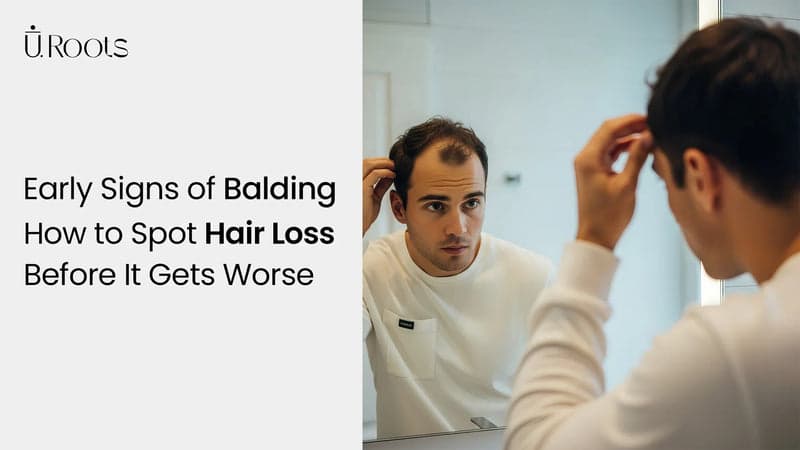
Early Signs of Balding: Spot Hair Loss Early & Take Action
Reviewed by QHT Clinic
Know Your Hair Fall Before It Worsens
Identify early hairfall signs with personalised expert-backed recovery guidance.
Hair is not just a feature on your face, it signifies confidence, personality and the way you express yourself. When you notice little changes in the thickness of your hair or its pattern you might become self-conscious or anxious. An opportunity to detect the onset of baldness can help you to take the necessary steps in a short period of time, retain your hair, and perhaps restore it.
This blog will help you identify early signs of hair thinning in men and women , hair loss causes and how to treat it effectively before it is too late.
Understanding The Hair Growth Cycle
The correct way of identifying early balding signs is to know how hair grows in the first place. Every strand of hair that grows on your scalp passes through a natural growth cycle which is of three stages:
Anagen (Growth phase): The phase lasts between 2–7 years during which the hair continues growing.
Catagen (Transitional stage): It is approximately 2 weeks. In this stage hair growth slows down.
Telogen (Resting phase): This stage is approximately 3 months. This is followed by hair loss followed by the growth of new hair.
When the cycle gets interrupted by genetics, hormones or stress the growth stage becomes shorter. The hair sheds more readily, grows back finer and ends up appearing in the usual patterns of baldness in men or women.
What Causes Early Balding?
A lot of individuals nowadays may experience early balding, also referred to as androgenetic alopecia, which may begin as early as the late teens or twenties. Being aware of the reasons why it occurs makes you act before it deteriorates.
1. Genetics
When baldness is a family problem you have higher chances of getting it. Genes in the family also determine the way your scalp responds to a hormone known as Dihydrotestosterone (DHT) which is used to shrink the hair follicles.
2. Hormonal Changes
In men, elevated DHT results in hair bald at the hairline and the top. Hormonal imbalance in women due to PCOS or pregnancy or menopause may lead to thinning of the entire scalp rather than uniform patches.
3. Stress and Lifestyle
Poor diet, low sleep and high stress accelerate hair loss. Cortisol increases under the influence of stress and disrupts the hair cycle.
4. Scalp Conditions
Dandruff, fungus or constant inflammation damages the hair roots and causes difficulties in developing new hair.
5. Nutritional Deficiencies
Lack of sufficient protein, biotin, iron, zinc or vitamin D predominantly contributes to premature hair thinning and dull hair. Premature hair loss can be slowed at least or reversed with an early diagnosis and treatment before it progresses to an irreversible stage.
Symptoms of Balding That You Must Not Miss
Early detection of balding will leave you with an opportunity to initiate interventions.
1. Little Thinning on the Crown
The initial sign of balding in men is light hair on the crown (top of the scalp). The patch is increasing in size with time and displays an apparent round area, which is bald. Rather than having a single bald spot, women tend to have hair thinness around the top.
2. Receding Hairline
In men, the temples usually recede in an M-shaped or U-shaped pattern. Women’s hairline remains unchanged, however, hair around the forehead or mid-scalp may become thin.
3. Finding More Hair on your Pillow or Shower drain
You know you’re losing too much hair when you notice lots of strands on your pillow, comb, or in the drain. The usual loss is 50–100 hairs per day thus some additional loss may occur due to premature balding.
4. Wider Part Line
The most noticeable sign of hair loss in women is a widening hair part. When you part your hair, the scalp looks emptier, and the hair may appear uneven on both sides.
5. Changes in Hair Texture
When hair is finer or shorter or weaker it may be due to shrinking follicles. You might find your hair not growing at all or have a hard texture.
6. Itchy or Inflamed Scalp
Inflammation or dandruff may be indicated by an itchy scalp, flaking or slight redness. These can worsen shedding. Scalp issues seem to be the most frequent triggers that are identified by the team at QHT Clinic.
7. Excessive Hair Breakage
When strands tear easily or your ponytail is thin, then it might be a sign of weaker roots and early follicle shrinkage.
Pattern Baldness Male vs Female: The Differences
Although they are both hormonally and genetically caused, the balding pattern in men and women is different.
In Men
Commences at the temples and crown.
Slow development of an M-shaped or horseshoe shape.
Total baldness can take place in later stages.
In Women
The hairline remains preserved.
Hair scalp thinning, particularly at the top of the head.
Infrequently causes total baldness.
At QHT Clinic, specialists apply tools such as trichoscopy and scalp imaging to map these patterns with a high degree of precision to create individualised hair fall treatment programmes.
How to Check to See whether You are Balding Early?
Occasionally, balding may pass off as normal shedding or seasonal loss of hair. To confirm, you can:
Tug a few strands of dry hair. If more than 5–6 strands come out when you touch or comb your hair, it can be an indication of active hair loss.
Use similar lighting and take monthly photos. Early balding areas or a decrease in volume are evident with the passage of time.
At QHT Clinic, doctors use a trichoscopic examination, a magnified view of your hair follicles, to detect miniaturisation before visible thinning appears.
What to Do When You Notice Early Balding?
It is one of the first symptoms of balding: you should not panic, but take action. These are some ways to take back control:
Some methods to delay or even prevent early baldness include:
Minoxidil: a prescription drug which is available in topical or oral form that prevents hair loss.
Finasteride (men only): reduces the hormones that lead to hair loss.
Platelet-Rich Plasma (PRP): involves the use of your own blood to stimulate hair growth.
Low-Level Laser Therapy (LLLT): provides cells with a growth enhancement therapy.
A thorough scalp check is performed at QHT Clinic to ensure that every patient receives the most effective plan at the lowest possible risk.
Day-to-day activities are important for scalp health.
Consume foods that are rich in proteins such as eggs, fish and lentils.
Take in an adequate amount of water to maintain blood circulation in the scalp.
Get 7–8 hours of sleep daily to reduce stress hormones.
Stress can be managed through meditation, yoga or exercise.
In the case of mild and moderate, it is possible to add gentle natural steps.
Aloe Vera: Soothes swelling and maintains skin hydrated.
Coconut Oil: nourishes roots and prevents the loss of proteins.
Green Tea: Its antioxidants could reduce the harmful hormone.
Onion Juice: Can increase blood circulation and restore growth in bald areas at a tender age.
When shedding continues, it is significant to have a professional plan for hair fall.
A good scalp means good hair.
Take a shower daily with mild shampoo to maintain a clean scalp.
Wash off the scalp using a hair scrub once a week to open up the blocked follicles.
Strong chemicals and dyes, and excessive heat styling should be avoided.
QHT Clinic recommends a monthly scalp detox to create an ideal environment for healthy hair regrowth.
1. Does stress cause premature balding?
Yes, prolonged stress increases cortisol and the hair goes into shedding. Cutting stress helps a lot.
2. What are the differences between normal hair loss and balding?
The normal shedding is below 100 hairs per day. Continuous thinning or a visible scalp indicates balding.
3. Are hair fall prevention treatments permanent?
Drugs such as Minoxidil and PRP maintain the well-being of hair as long as they are used. Consistency matters.
4. Do women also get baldness?
Yes. Women develop female pattern baldness that is mild but prevalent particularly after hormonal changes or menopause.
5. Are home remedies a total cure for balding?
Home medicines are beneficial in promoting the state of the scalp but do not typically prevent genetic baldness. Treatment through medication is the best.
Conclusion
Hair loss can progress quietly but quickly, moving from mild thinning to noticeable baldness within months. It all depends on the ability to spot the early signs and seek assistance at an early stage. At QHT Clinic, patients receive professional treatment considering their hair and objectives, which guarantees safe and evidence-based healing. You may have a receding hair line, widening part, or you may be shedding more, the thing is, as the old saying goes, there is no time like the present. Your hair is your story, and we want QHT Clinic to make it robust, self-assured, and successful.
Know Your Hair Fall Before It Worsens
Identify early hairfall signs with personalised expert-backed recovery guidance.
Back to blog { "@context": "https://schema.org", "@type": "MedicalWebPage", "@id": "https://theuroots.com/blogs/news/early-signs-of-balding-hair-loss#webpage", "url": "https://theuroots.com/blogs/news/early-signs-of-balding-hair-loss", "name": "Early Signs of Balding: How to Spot Hair Loss Before It Gets Worse", "description": "Hair is not just a feature on your face, it signifies confidence, personality and the way you express yourself. When you notice little changes in the thickness of your hair...", "isPartOf": { "@type": "WebSite", "@id": "https://theuroots.com#website", "name": "TheUroots", "url": "https://theuroots.com" }, "reviewedBy": { "@type": "Person", "name": "Dr. Ajay, MBBS, QHT Clinic", "jobTitle": "Medical Reviewer", "affiliation": { "@type": "MedicalOrganization", "name": "QHT Clinic", "url": "https://qhtclinic.com/" } }, "author": { "@type": "Organization", "name": "URoots Editorial Team" }, "datePublished": "2025-11-22T16:26:05+0530", "dateModified": "2025-11-22T16:26:08+0530" } Browse
Related Blogs
Discover reliable, doctor-written health resources online for accurate guidance, trusted information, and better informed medical decisions.
15th May 2026 Best Foods for Hair Growth: A Nutritionist-Approved Diet Plan Hair fall can be upsetting for both men...
15th May 2026 The Complete Guide to Androgenetic Alopecia (Male Pattern Baldness) Hair loss often begins subtly, a slightly receding...
07th Feb 2026 Hormones & Hair: How Thyroid, PCOS & Androgens Play a Role Hormone-related hair loss is a common yet often...
01th Sep 2026 Rosemary Oil & Water for Hair: Evidence Review Rosemary oil and rosemary water are among the...
Book Your Consultation
We're always here for hair help.
Shop
Hair Test
Contact
Our Story & Philosophy
Experts Panel
Blogs
Khasara No. 1395/684/2, Crown Complex, NH-8, Exit No. 12, Near Hero Honda Chowk, Gurugram,
+916399110555
care@theuroots.com
Grievance Officer: Mr. Sumit QHT Email: grievance@theuroots.com
Privacy Policy
Payment Terms & Conditions
Cancellation / Refund Policy
Terms & Conditions
Shipping Policy
URoots Hair Serum
URoots Max Cyclical Therapy
URoots Hair Supplement
URoots Daily Hydrating Shampoo
URoots Finasil Tablets
URoots Minoxidil 5% Solution
Uroots Minoxidil 5F+ Daily Scalp
© 2026 QHT Mediways. All Rights Reserved
Choosing a selection results in a full page refresh.
Opens in a new window.
URoots Hair Care Expert × Hi! Welcome to URoots. Before we begin, please share your name and phone number so our team can follow up with you.
✅ Thank You, ! Your responses have been recorded.
Our hair care experts at URoots will review your details and get in touch with you shortly on to guide you on the best path forward.
Typically, our team responds within 24 working hours. We look forward to being part of your hair care journey!
This article is general information, not a diagnosis. Hair loss has several causes and the right treatment depends on yours.
Talk to a doctor