Finasteride vs Dutasteride: Best Treatment for Hair Loss in 2025
Reviewed by QHT Clinic
Know Your Hair Fall Before It Worsens
Identify early hairfall signs with personalised expert-backed recovery guidance.
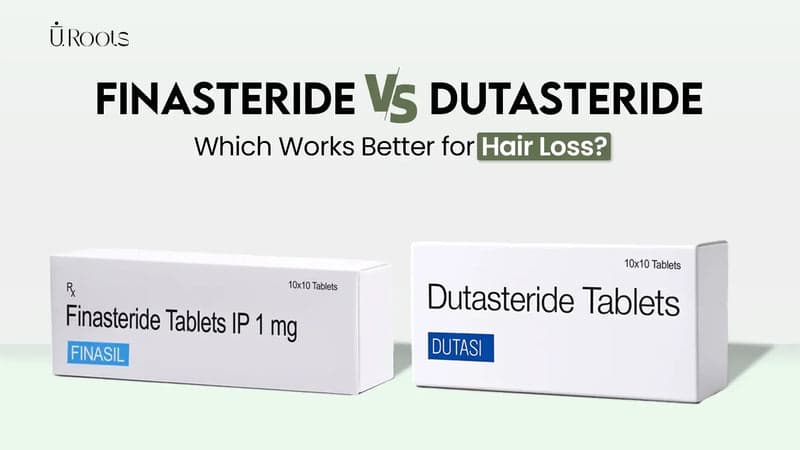
Hair loss is gradual, annoying, and frequently caused by just one biochemical trigger called dihydrotestosterone (DHT). Over time, DHT causes hair follicles in men (and occasionally women) to diminish, resulting in thinning and eventually baldness. Medicine has provided us with two effective tools, finasteride and dutasteride, to halt this process.
Both medications target the enzyme that converts testosterone to DHT and are classified as 5-alpha reductase inhibitors. Despite having a similar objective, they differ in subtle but significant ways in terms of impact, effectiveness, and clinical results.
Understanding this distinction is essential to creating an ideal hair loss therapy plan at QHT Clinic, one that is safe, sustainable, and effective for long-term results.
Let's dive into Finasteride and Dutasteride in detail, contrasting their mechanisms, advantages, and disadvantages to help you decide which might be more effective for your hair repair process.
Recognizing the Fundamental Cause: Hair Miniaturization and DHT
We must first comprehend what DHT does to fully comprehend how finasteride and dutasteride, which are used for hair loss, function.
The enzyme 5-alpha reductase reacts with testosterone to produce dihydrotestosterone, or DHT, a powerful form of testosterone. It is important during puberty because it deepens the voice and encourages the growth of body hair. But as people get older, it starts to play a significant role in androgenetic alopecia, or male pattern baldness.
Miniaturization is the process by which DHT attaches to receptors in scalp hair follicles, which causes them to gradually diminish and produce thinner, shorter hair. Follicles eventually cease to produce any discernible hair at all.
Therefore, the treatment's objective is straightforward: to block or lower DHT to safeguard follicles and promote the development of healthy hair.
Finasteride for Hair Loss
Finasteride was the first oral medication approved by the FDA for male pattern hair loss. It functions by blocking the 5-alpha reductase enzyme's Type II form, which is mostly present in the prostate and hair follicle tissue.
How It Operates
Finasteride lowers serum and scalp DHT levels by about 60to 70% by inhibiting this enzyme. This promotes stronger, thicker hair by reversing the miniaturization of follicles.
Form and Dosage
For hair loss, finasteride is typically prescribed as a 1 mg tablet per day (the higher dose of 5 mg is utilized for prostate enlargement).
Findings
The majority of men experience less shedding in three to six months, and between six and twelve months, there is noticeable regrowth. Results are maintained when used consistently; discontinuing use could undo gains.
Benefits
decades of use and a proven safety record
FDA-approved for pattern baldness in men
Effective for mild to slight hair loss
maintains existing hair, and slows down growth.
Restrictions
For severe hair loss, it might not be as effective.
only inhibits Type II enzymes, not Type I ones.
For long-lasting effects, daily use must be consistent.
Finasteride remains the gold standard for early intervention, reliable, well-studied, and widely tolerated.
Dutasteride for Hair Loss
Finasteride was followed by the more recent and powerful 5-alpha reductase inhibitor dutasteride. It is unique in that it inhibits each Type I and Type II enzymes, resulting in a more comprehensive and potent reduction of DHT production.
How It Operates
Dutasteride can reduce DHT levels on the scalp by more than 90% by affecting both enzyme types, while finasteride can only reduce DHT levels by 60to 70%. Some patients, particularly those with moderate to severe hair loss, experience more robust regrowth as a result of this deeper inhibition.
Form and Dosage
Although frequency may vary depending on clinical judgment, 0.5 mg per day is the usual quantity used for hair restoration.
Findings
After three to six months, patients frequently report noticeable changes, with notable advancements occurring between nine and twelve months. Particularly in the crown and middle of the scalp areas, the regrown hair usually appears denser.
Benefits
Greater suppression of DHT (targets both types of enzymes)
More efficient for stages of advanced hair loss
could result in denser and quicker regrowth
Results that last with continued use
Restrictions
A marginally increased chance of hormonal adverse effects
Greater half-life (longer time spent in the system)
Although frequently prescribed off-label, it is not approved by the FDA for reducing hair loss in all nations.
While finasteride plateaus or does not produce the desired density, dutasteride is frequently thought of as the next step up.
Finasteride vs Dutasteride: A Detailed Comparison
Feature
Finasteride
Dutasteride
Enzyme Target
Type II only
Type I & II
DHT Reduction
About 60to 70%
About 90%
Dosage
1 mg/day
0.5 mg/day
Onset of Results
4to 6 months
3to 5 months
Effectiveness for Advanced Hair Loss
Moderate
Higher
Side Effect Risk
Lower
Slightly higher
Half-Life
6 to 8 hours
4to 5 weeks
FDA Approval for Hair Loss
Yes
Off-label use
Ideal Candidate
Early to moderate hair loss
Moderate to advanced hair loss
One thing is evident from this comparison: Finasteride is still a good option for people starting early, but Dutasteride provides stronger suppression and might be better for severe cases.
Side Effects and Safety Profile
Since both drugs are members of the same pharmacological family, their adverse effect profiles are comparable. The majority of patients handle them well, but understanding is essential.
Potential Adverse Reactions
Momentary decline in libido
Erectile dysfunction that is mild
Diminished volume of semen
Fullness or tenderness of the breasts
Occasionally, mood swings or exhaustion
Notably, only a small percentage of users experience these side effects, which are typically reversible upon stopping the medication. In reality, when therapy is prescribed and properly monitored, the majority of individuals at QHT Clinic do not experience any discernible side effects.
Extended Use
Under a doctor's supervision, finasteride and dutasteride can both be taken safely for years. Regular examinations guarantee stable liver health and hormone balance.
Who Should Use Finasteride?
Men who are in the initial stages of recession or hair thinning are the best candidates for finasteride.
Do you want an FDA-approved, clinically proven solution?
Choose a medication that is milder and has a smaller systemic impact.
We're dedicated to regular, sustained use.
Finasteride is an effective preventive treatment for patients who are younger or those with family history of baldness. It helps preserve an appearance of fullness for years in addition to halting progression.
Who Should Use Dutasteride?
Men who have slight to advanced hair loss, particularly in the crown and mid-scalp, are good candidates for dutasteride.
Did not react favorably to finasteride
Desire denser, quicker regrowth
Under medical supervision, they can comply with a stronger DHT blocker.
When they hit an endpoint, many QHT patients switch from finasteride to dutasteride, a calculated move that can restart stalled regrowth phases.
When Finasteride and Dutasteride Are not Enough
Treatment at QHT Clinic is multifaceted. Although medicine provides the framework, combining therapies like these often yields the best results.
Platelet-Rich Plasma, or PRP: improves drug response and promotes follicle repair.
Low-Level Laser Therapy (LLLT): Enhances follicle metabolism and blood flow.
Nutraceutical Support: Supplements that balance DHT, vitamins, and biotin improve the general health of the scalp.
Topical minoxidil: Encourages the growth of new follicles, which enhances DHT blockers.
In some resistant cases, QHT hair transplants are combined with medications that provide both visible density restoration and biological protection.
The QHT Clinic makes a precise decision about whether to prescribe Finasteride or Dutasteride based on the patient's age, hormone profile, diagnosis, and expectations.
We evaluate follicle volume, pattern, and sensitivity as part of our comprehensive scalp analysis process.
Hormonal Evaluation: Adjusting dosage by balancing DHT and testosterone.
Depending on the severity, treatment planning may involve choosing finasteride, dutasteride.
Monitoring: Consistent follow-ups to monitor response, reduce adverse effects, and modify treatment.
Every patient will receive the most suitable hair loss treatment possible thanks to this methodical approach, which guarantees that it is safe, effective, and in line with long-term restoration objectives.
Finasteride vs Dutasteride: Which Works Better Overall?
The response is contingent upon your goals, biology, and hair loss stage.
Finasteride provides consistent results with a milder effect if you're starting early or wish to preserve your current density.
Dutasteride frequently works better if you've made more progress, have crown thinning issues, or want quicker results.
The difference between the two medications is the amount and speed at which hair can be preserved and regrows.
To ensure the safest and most efficient path to recovery, we at QHT Clinic frequently start with finasteride and switch to dutasteride if the reaction plateaus.
Because of the possible hormonal effects, these drugs are typically not prescribed to women who are of childbearing age. Postmenopausal women, however, might be subject to close medical supervision.
Discontinuation raises DHT levels once more, which could result in fresh shedding in a few months. The secret is consistency.
Indeed. Although their efficacy varies, local products are accessible and may lessen systemic exposure.
Of course. In order to preserve native hair and stop further thinning, they are actually frequently included in post-transplant care.
Finasteride vs. Dutasteride is a personal decision; there is no clear winner. By addressing the underlying cause of male pattern baldness, both drugs have transformed the hair restoration industry.
Our aim at QHT Clinic is to customize your care to meet your comfort level, expectations, and biology. Every plan is supported by science and executed precisely, whether you're starting with Finasteride, moving up to Dutasteride, or integrating medical therapy with cutting-edge transplantation.
Schedule an appointment at QHT Clinic if you're prepared to take charge of the health of your hair. Allow our professionals to assist you in locating the most effective, safe, and genuinely transformative hair loss treatment that is tailored to your needs.
Know Your Hair Fall Before It Worsens
Identify early hairfall signs with personalised expert-backed recovery guidance.
Back to blog { "@context": "https://schema.org", "@type": "MedicalWebPage", "@id": "https://theuroots.com/blogs/news/finasteride-vs-dutasteride-for-hair-loss#webpage", "url": "https://theuroots.com/blogs/news/finasteride-vs-dutasteride-for-hair-loss", "name": "Finasteride vs Dutasteride: Which Works Better for Hair Loss?", "description": "Hair loss is gradual, annoying, and frequently caused by just one biochemical trigger called dihydrotestosterone (DHT). Over time, DHT causes hair follicles in men (and occasionally women) to diminish, resulting...", "isPartOf": { "@type": "WebSite", "@id": "https://theuroots.com#website", "name": "TheUroots", "url": "https://theuroots.com" }, "reviewedBy": { "@type": "Person", "name": "Dr. Ajay, MBBS, QHT Clinic", "jobTitle": "Medical Reviewer", "affiliation": { "@type": "MedicalOrganization", "name": "QHT Clinic", "url": "https://qhtclinic.com/" } }, "author": { "@type": "Organization", "name": "URoots Editorial Team" }, "datePublished": "2025-11-06T13:04:44+0530", "dateModified": "2025-11-06T13:08:27+0530" } Browse
Related Blogs
Discover reliable, doctor-written health resources online for accurate guidance, trusted information, and better informed medical decisions.
15th May 2026 URoots vs Other Hair Loss Brands in India: An Honest Comparison Struggling with hair fall and have tried every...
15th May 2026 Hair Loss Treatments Compared: Which Option Is Right for You? Hair loss is a very prevalent condition that...
15th May 2026 Hair Loss In Women: Causes, Treatment and What Actually Works Hair loss in women is no longer occasional;...
15th May 2026 Why Is My Hair Falling Out More Than Usual? (When to See a Doctor) Noticing more hair on your pillow, clumps falling...
Book Your Consultation
We're always here for hair help.
Shop
Hair Test
Contact
Our Story & Philosophy
Experts Panel
Blogs
Khasara No. 1395/684/2, Crown Complex, NH-8, Exit No. 12, Near Hero Honda Chowk, Gurugram,
+916399110555
care@theuroots.com
Grievance Officer: Mr. Sumit QHT Email: grievance@theuroots.com
Privacy Policy
Payment Terms & Conditions
Cancellation / Refund Policy
Terms & Conditions
Shipping Policy
URoots Hair Serum
URoots Max Cyclical Therapy
URoots Hair Supplement
URoots Daily Hydrating Shampoo
URoots Finasil Tablets
URoots Minoxidil 5% Solution
Uroots Minoxidil 5F+ Daily Scalp
© 2026 QHT Mediways. All Rights Reserved
Choosing a selection results in a full page refresh.
Opens in a new window.
URoots Hair Care Expert × Hi! Welcome to URoots. Before we begin, please share your name and phone number so our team can follow up with you.
✅ Thank You, ! Your responses have been recorded.
Our hair care experts at URoots will review your details and get in touch with you shortly on to guide you on the best path forward.
Typically, our team responds within 24 working hours. We look forward to being part of your hair care journey!
This article is general information, not a diagnosis. Hair loss has several causes and the right treatment depends on yours.
Talk to a doctor