PRP vs Hair Loss Medicines: Which is Worth Your Money?
Reviewed by QHT Clinic
Know Your Hair Fall Before It Worsens
Identify early hairfall signs with personalised expert-backed recovery guidance.
Regardless of whether it's crown thinning, an expanding part line, or excessive shedding, the majority of people ask themselves the same question when hair loss starts: Should I use PRP therapy or keep taking medications?
Both have devoted followers. Some people are convinced by PRP for hair loss, referring to it as the "natural way" to use your own plasma to grow hair. Others depend on medications for hair loss, such as finasteride and minoxidil, believing in the evidence and FDA approvals that support them.
We see both sides at QHT Clinic, and more importantly, we have seen how each side works with real Indian patients. This guide helps you make an informed choice by comparing PRP and hair loss medications in detail, looking at how they work, their pros and cons, their costs, and who they are best for.
PRP for Hair Loss: What Is It?
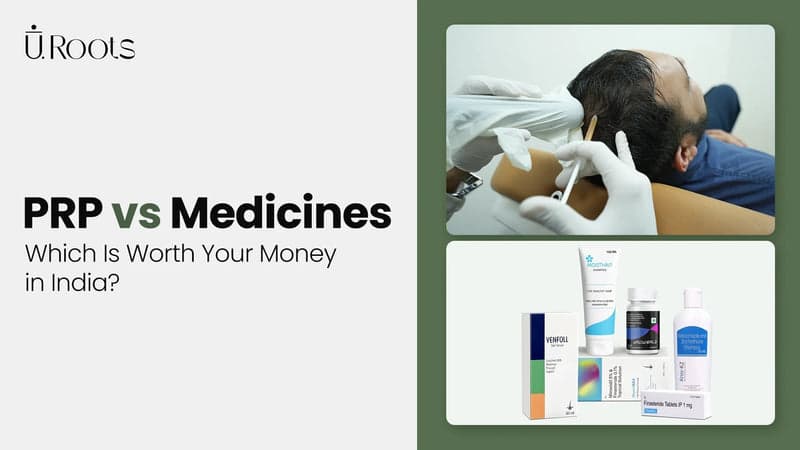
Platelet-rich plasma (PRP) therapy uses your own blood to help your hair grow. A small amount of your blood is taken, and then a centrifuge separates the platelets. The concentrated plasma, which is full of growth factors, is then injected into the parts of your scalp that are thinning.
The goal is simple: wake up dormant hair follicles and increase blood flow to help hair strands grow thicker and stronger. It is called a "natural" method because it uses your body's natural healing process and doesn't add any chemicals.
At QHT Clinic, they use precise PRP protocols to make sure that the injection depth, activation method, and platelet concentration are all carefully controlled to get reliable results.
What Are Hair Loss Medicines?
Medical treatment for androgenetic alopecia (pattern hair loss) is dominated by two main categories:
Minoxidil is a topical relaxant that thickens existing hair, extends the growth phase, and improves the supply of blood to the hair follicles.
Finasteride is an oral 5α-reductase inhibitor that decreases dihydrotestosterone (DHT), the hormone that causes follicles to shrink.
Topical anti-DHT sprays, nutraceuticals, low-dose oral minoxidil, and dutasteride are some of the more recent adjuncts and substitutes.
In contrast to PRP, medications target the hormonal and systemic factors that cause hair loss. Although they have scientific support, results depend on sustained dedication and regular use.
How Each Works, Science in Action
Aspect
PRP for Hair Loss
Hair Loss Medicines
Mechanism
Uses platelet-derived growth factors (PDGF, VEGF, IGF-1) to stimulate stem cells and improve follicle microcirculation.
Alters scalp environment and hormones, increases blood supply (minoxidil), reduces DHT (finasteride/dutasteride).
Application
Injected directly into the scalp every 4 to 6 weeks (in sessions).
Applied topically or taken orally daily.
Target
Strengthens existing follicles and reactivates dormant ones.
Prevents further hair loss and supports regrowth.
Onset of Results
Noticeable improvement in 3 to 6 months.
Improvement within 4 to 8 months (depending on consistency).
Maintenance
Requires periodic top-up sessions.
Continuous usage is required for sustained results.
PRP essentially nourishes and revitalizes, whereas medications preserve and protect.
1. Safe and natural
There is almost no chance of experiencing allergic or toxic side effects as PRP utilizes your own blood. Individuals who want minimal intervention or who are unable to take oral medications will find it particularly appealing.
2. Action in Multiple Pathways
PRP revitalizes the environment of the scalp by inducing the production of collagen, angiogenesis (the formation of new blood vessels), and growth factors.
3. Complements Other Therapies Well
PRP enhances the outcomes of medical therapy, QHT procedures, and FUE hair transplants. It is frequently used to promote graft survival and hasten healing after transplantation.
4. Minimal Downtime
You can get back to routine tasks within a day. Redness or mild soreness goes away in a few hours.
5. Improvement in Visible Density
When applied professionally, PRP frequently greatly increases scalp coverage and hair shaft thickness during initial to moderate thinning.
Limitations of PRP
PRP may seem like the answer, but it's not a miracle treatment.
Not for severe baldness: PRP is unable to regenerate new follicles once they are totally dead.
Session-based commitment: Typically calls for maintenance every six to twelve months in addition to three to six sessions spaced one month apart.
Results differ depending on the injection technique, platelet concentration, and equipment quality.
Cost: Initially, high-quality PRP (with authentic centrifuges and activators) may be more costly than prescription drugs.
Using cutting-edge double-spin centrifugation for constant platelet concentration rather than salon-grade "quick spins," we at QHT Clinic make sure PRP is carried out under medical-grade sterile conditions.
The Strengths of Hair Loss Medicines
The effectiveness of finasteride and minoxidil has been supported by decades of research. Dermatologists all over the world recommend them, and regulatory agencies like the FDA have approved them.
DHT suppression (with finasteride/dutasteride) is essential for androgenetic alopecia. PRP is unable to tackle this hormonal cause on its own; medications do.
In the long term, daily medications are less expensive than frequent PRP treatments.
Just regular daily care, no appointments, no needles.
Continued medication use helps preserve density and stop additional shedding following PRP or transplant.
Medicines' Limitations
Require consistency because stopping or missing doses causes gains to be reversed.
Possible side effects: A small percentage of finasteride users may experience hormonal changes or a decrease in libido.
Topical irritation: Some people may experience dry scalp or dandruff as a result of minoxidil.
Plateau effect: Following initial gains, results may plateau, necessitating combination therapy for additional improvement.
This is where QHT Clinic's combination plans come in, striking a balance between maximum efficacy and safety.
PRP vs Medicines for Hair Loss, Which Wins?
Parameter
PRP
Medicines
Type
Therapy that helps the body heal itself
Therapy with drugs
Best For
Early to moderate thinning, with improvement after transplant
Long-term care and stopping the disease from getting worse
Downtime
Minimal (1 day)
None
Side Effects
Slight pain and swelling that goes away
Possible hormonal or topical irritation
Timeline of Results
Three to six monthssults
Four to eight months
Price Range in India
Rs. 10,000 to Rs. 20,000 per session
1,000 to 3,000 rupees per month
The Best Mix
Works best with medicines for sustained outcomes
PRP makes it work faster.
The Unique Blend, Not "Either/Or," but "Both"
PRP and medications are rarely viewed as competitors at QHT Clinic. We view them as teammates instead.
Consider medications as guardians; they regulate hormones and prevent additional hair loss.
Consider PRP as a constructor since it thickens, revitalizes, and strengthens the remaining hair.
They form a complete ecosystem for regrowth when combined. For noticeable improvement, the majority of our patients begin with medical therapy before switching to PRP, or the other way around.
Cost Comparison: Is PRP Worth It in India?
In India, PRP for hair loss typically costs within Rs. 10,000 and Rs. 20,000 per session, depending on the caliber of the clinic, the equipment used, and the skill of the doctor. Three to six sessions may be part of a comprehensive treatment plan.
On the other hand, according to the combination (minoxidil, finasteride, or nutraceuticals), medications usually cost between Rs. 1,000 and Rs. 3,000 per month.
Over one year, PRP provides a quicker apparent boost at a higher initial cost.
Long-term affordability and consistent maintenance are provided by medications.
At QHT Clinic, we advocate for individualized treatment mapping, in which the physician examines your stage, hormone levels, scalp density, and financial situation before creating a comprehensive plan.
How QHT Clinic Delivers Results
QHT Hair Transplants and Hair Transplant Repair services provide the right techniques, surgeons, natural results, the least recovery time, and proper aftercare to the patients for long-term success. 1. Celebrity Trusted
QHT Clinic is trusted by celebrities for their Crown Hair Transplant.
2. Clinical Expertise With years of experience in handling Crown Hair Transplant cases, QHT Clinic delivers the best results.
3. Natural Results.
Our expert surgeons and methods give natural hairlines and improved density in cases of Crown Hair Transplant.
4. Best Facilities
QHT clinic is equipped with the best technology and advanced techniques to yield a seamless experience.
Realistic Expectations: What You Can Expect
The density, strength, and volume should gradually improve over the course of three to six months following PRP. Annual maintenance sessions might be recommended.
Following medication, hair loss stabilizes in three to four months, with noticeable regrowth starting in month six.
Combined Therapy: Longer-lasting effects, enhanced texture, and quicker recovery.
Although the process takes time, the transformation is long-lasting with perseverance and medical supervision.
Conclusion
The answer to the question of whether PRP or medications produce "better" results is that they address different aspects of the same issue.
PRP provides noticeable density and scalp revitalization if your hair is thinning but your follicles are still alive.
If your hair loss is genetically driven or progressing, medications can help prevent more harm.
Combining the two produces the best, most durable results for the majority of patients.
The dermatologists at QHT Clinic assess your medical history, hair loss pattern, and scalp health before recommending a customized treatment plan that may involve PRP, medication, or a combined approach.
Make your decision based on knowledge, sustainability, and science rather than just price.
Make an Appointment at QHT Clinic Right Now
Trial and error isn't enough for your hair. Get a personalized, open evaluation from our professionals to begin your path to healthier, fuller hair.
Know Your Hair Fall Before It Worsens
Identify early hairfall signs with personalised expert-backed recovery guidance.
Back to blog { "@context": "https://schema.org", "@type": "MedicalWebPage", "@id": "https://theuroots.com/blogs/news/prp-vs-hair-loss-medicines-cost-india#webpage", "url": "https://theuroots.com/blogs/news/prp-vs-hair-loss-medicines-cost-india", "name": "PRP vs Medicines: Which Is Worth Your Money in India?", "description": "Regardless of whether it's crown thinning, an expanding part line, or excessive shedding, the majority of people ask themselves the same question when hair loss starts: Should I use PRP...", "isPartOf": { "@type": "WebSite", "@id": "https://theuroots.com#website", "name": "TheUroots", "url": "https://theuroots.com" }, "reviewedBy": { "@type": "Person", "name": "Dr. Ajay, MBBS, QHT Clinic", "jobTitle": "Medical Reviewer", "affiliation": { "@type": "MedicalOrganization", "name": "QHT Clinic", "url": "https://qhtclinic.com/" } }, "author": { "@type": "Organization", "name": "URoots Editorial Team" }, "datePublished": "2025-12-18T18:34:37+0530", "dateModified": "2025-12-18T18:34:42+0530" } Browse
Related Blogs
Discover reliable, doctor-written health resources online for accurate guidance, trusted information, and better informed medical decisions.
15th May 2026 URoots vs Other Hair Loss Brands in India: An Honest Comparison Struggling with hair fall and have tried every...
15th May 2026 Post Hair Transplant Medicine: The Complete Guide to Healing & Recovery A hair transplant takes nine to twelve months...
15th May 2026 Hair Loss In Women: Causes, Treatment and What Actually Works Hair loss in women is no longer occasional;...
15th May 2026 Why Is My Hair Falling Out More Than Usual? (When to See a Doctor) Noticing more hair on your pillow, clumps falling...
Book Your Consultation
We're always here for hair help.
Shop
Hair Test
Contact
Our Story & Philosophy
Experts Panel
Blogs
Khasara No. 1395/684/2, Crown Complex, NH-8, Exit No. 12, Near Hero Honda Chowk, Gurugram,
+916399110555
care@theuroots.com
Grievance Officer: Mr. Sumit QHT Email: grievance@theuroots.com
Privacy Policy
Payment Terms & Conditions
Cancellation / Refund Policy
Terms & Conditions
Shipping Policy
URoots Hair Serum
URoots Max Cyclical Therapy
URoots Hair Supplement
URoots Daily Hydrating Shampoo
URoots Finasil Tablets
URoots Minoxidil 5% Solution
Uroots Minoxidil 5F+ Daily Scalp
© 2026 QHT Mediways. All Rights Reserved
Choosing a selection results in a full page refresh.
Opens in a new window.
URoots Hair Care Expert × Hi! Welcome to URoots. Before we begin, please share your name and phone number so our team can follow up with you.
✅ Thank You, ! Your responses have been recorded.
Our hair care experts at URoots will review your details and get in touch with you shortly on to guide you on the best path forward.
Typically, our team responds within 24 working hours. We look forward to being part of your hair care journey!
This article is general information, not a diagnosis. Hair loss has several causes and the right treatment depends on yours.
Talk to a doctor